Arcade vs Simulation Tank Games: Which Style Is for You?
Arcade vs simulation tank games compared on realism, learning curve and session length, plus where mixed reality tank combat fits in for headset players.
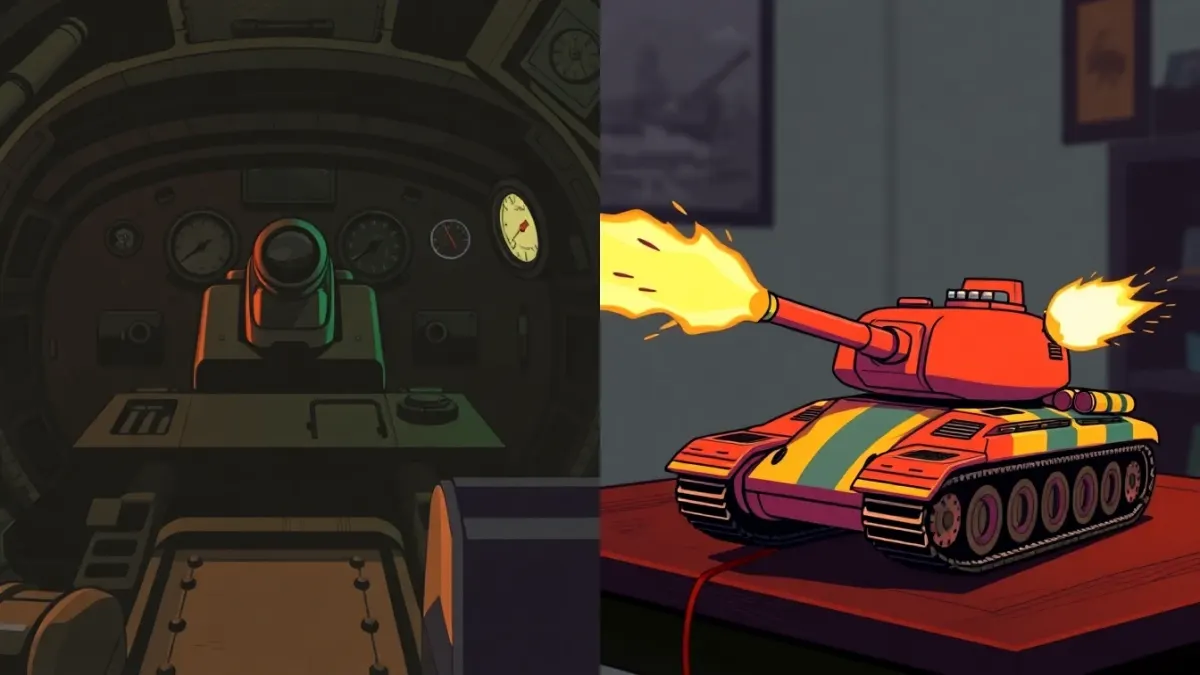
Arcade tank games prioritize fast, readable fun. Simulation tank games prioritize realism and depth. Neither is better; they answer different questions. If you want to jump in and be shooting within seconds, you are an arcade player. If you enjoy learning armor angles and procedures, simulation is your territory. Here is how to tell which camp you belong to.
The key differences
| Arcade | Simulation | |
|---|---|---|
| Learning curve | Minutes | Hours or longer |
| Rules | Simple and consistent | Complex and realistic |
| Session length | Short rounds | Longer engagements |
| Fantasy | Fun first | Authenticity first |
| Typical tools | Power-ups, special attacks | Ammunition types, crew management |
What arcade tank games do well
Immediate clarity. You see a shell bounce, you understand why you died, and you want one more go. Tank Avenger: Mixed Reality is in this camp. Its Normal Gun bullets bounce once off walls, its Fast Gun fires rapidly with double bounces, and its Heat Gun bullets track the player. These are rules you learn by seeing them.
Spectacle and variety. Power-ups and special moves add drama. In Tank Avenger you can call on a Shield, Speed Boost, Extra Life, Combat Drone, Portal or Air Strike, and even fly a helicopter.
Easy to share. Because the rules are simple, a friend watching over your shoulder gets it quickly.
What simulation games do well
Depth. Simulators reward study. You learn why a certain angle matters or how to manage resources.
Authenticity. For people interested in military hardware or history, realism is the entire point.
Slow-burn satisfaction. A well-executed tactic after careful planning can feel richly rewarding.
Why mixed reality favors arcade
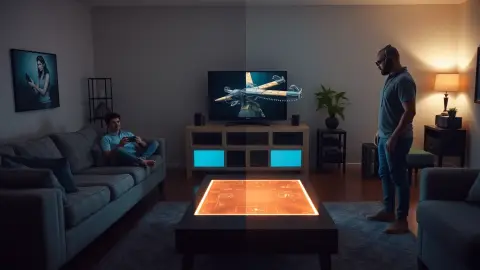
Wearing a headset in your living room has practical limits. Sessions are usually shorter, controls need to be learnable without a manual, and your attention is split between the game and your actual space. Arcade design handles that well.
There is also a visual reason. At table scale, passthrough video is not as crisp as real life, so objects must be bold and readable. A chunky, toy-like tank survives that; a hyper-detailed one would not.
Hybrid ground
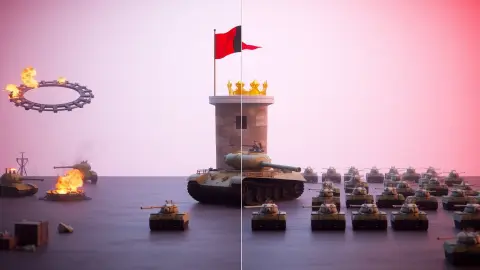
The line is not absolute. Arcade games can have strategic depth, and simulations can have accessible modes. Tank Avenger shows some of that depth: six weapons you can each upgrade, four game modes (Deathmatch, Capture the Flag, Juggernaut, Survival), and four worlds that change how you play, from the open sightlines of the desert to the sliding tanks of the ice world.
How to decide in five minutes
- Do you enjoy reading manuals? Lean simulation.
- Do you prefer to learn by playing? Lean arcade.
- Do you play in 10 to 20 minute bursts? Lean arcade.
- Do you care about historical accuracy? Lean simulation.
- Want the war in your actual living room? Mixed reality arcade, such as Tank Avenger.
Safety note
Whichever style you pick in mixed reality, clear your play area, keep the room lit and take breaks. Tank Avenger's terms remind players that virtual objects do not protect you from real ones.
Can you enjoy both?
Plenty of players do. A common pattern is to use simulation games for evenings when you want to study and arcade games when you want release. The skills partly transfer: understanding angles and cover helps in both. If you are unsure, try an arcade title first, since the commitment is lower, and move toward simulation only if you find yourself wanting more realism. Trying a mixed reality arcade game also costs little in learning time, so it is an easy way to discover whether you enjoy hands-on tank combat in the first place.
FAQ
What is an arcade tank game?
It is a tank game focused on quick, easy-to-learn action and fun rather than realistic simulation of vehicles, armor or crews.
Are simulation tank games harder?
Usually, because they require learning more systems. Difficulty also depends on settings and on the individual game.
Is Tank Avenger arcade or simulation?
It is an arcade-style mixed reality tank game with bouncing bullets, special abilities, upgradeable weapons and four game modes.
Which style suits a headset better?
Arcade design tends to suit short headset sessions and the clarity limits of passthrough, though that is a general observation rather than a rule.