Horror Game Design 101: Tension, Release and Pacing
Horror game design explained through tension, release and pacing: how designers build fear in waves and what a chapter-based game can learn from it.
Fear is not a constant. A game that is frightening at maximum volume all the time stops being frightening, because players adapt. Horror game design tension and pacing is the craft of controlling how fear rises, peaks and falls. Here is a practical overview.
Fear needs contrast
Imagine a graph of how tense a player feels. A flat high line becomes numb. A line that climbs, spikes and drops again keeps feeling dangerous. Designers speak of waves: build-up, peak, recovery, then a slightly higher build-up.
Building tension
Tension is the promise that something will happen. Common tools:
- Information gaps. You hear it but cannot see it.
- Limited resources. Few bullets, a fading light.
- Uncertainty. You do not know where the threat is or when it arrives.
- Environmental cues. Flickering light, silence, a sound from the next room.
Release
Release is not always a jump scare. It can be the monster appearing, a fight, or simply a moment of safety. Without release, tension has nowhere to go. With too much release too soon, it never builds.
Recovery matters
Quiet moments are not filler. They let the player breathe so the next build-up has room to grow. In a chapter-based game like HAUNTED: Are You Alone?, a shop between chapters where you upgrade weapons doubles as a pressure valve. You spend what you earn to make the next night survivable, and you may find the hidden things the game leaves in the shop.
Varying the type of threat
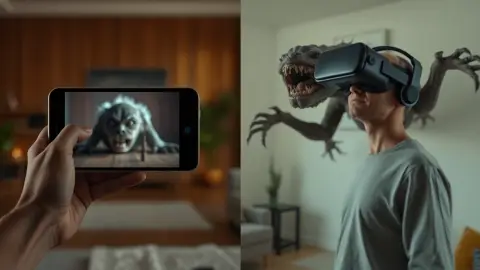
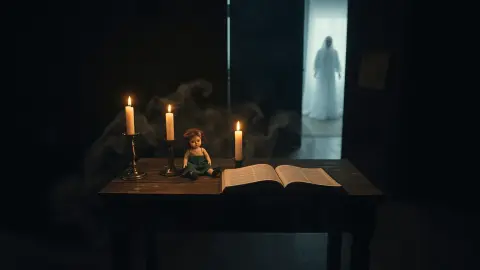
If every scare arrives the same way, players learn to expect it. HAUNTED mixes its threats: arms smashing through walls to be sliced apart, skulls to shoot or freeze in a flashlight beam, a graveyard to hold with firearms, blood rising across the room, drills that react to your gaze, a puppy leading you into a cave, a cursed doll, a nun and a teleporting witch. Each asks something different of you.
The role of agency
Pure helplessness can be frightening, but it can also feel unfair. Giving the player tools creates a different mix of fear and empowerment: you are scared and swinging an axe. The balance between power and vulnerability is a core design dial.
Pacing in a physical game
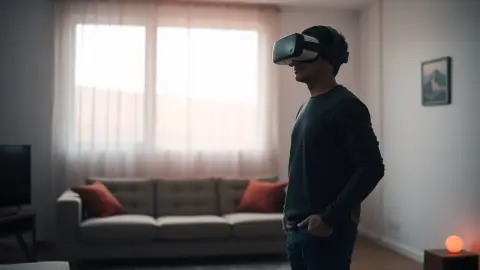
In mixed reality, pacing involves the body. Constant swinging and ducking is tiring. Designers need rest beats where you stand still and listen, which are often the scariest moments anyway.
Sound as a pacing tool
Silence is as important as noise. A sudden drop in sound tells players something is coming. Spatial audio then gives that threat a direction.
Lessons for players
If you want to enjoy horror more:
- Treat quiet sections as part of the experience, not dead time.
- Take breaks between sessions if you feel wound up.
- Remove the headset any time you feel unwell.
Pacing only works if the player can cope with the peaks, and this game's peaks are strong: sudden loud sounds, flashing and darkened light, gore and intense jump scares. Its makers say it is not suitable for children, people who are pregnant, or anyone with epilepsy, heart conditions or anxiety disorders.
A simple pacing exercise
If you want to see pacing for yourself, play a session with a stopwatch in mind, or just note how you feel every few minutes. Write down moments of high tension, moments of rest, and moments of surprise. You will probably find a rhythm: a build, a peak, a pause, another build. Many players are surprised by how often the quiet parts are the most memorable.
This is also a helpful way to decide when to stop. If you notice your tension never drops, you may be pushing too hard; step away. The best horror experiences are designed with breathing room, and so should your evening be. A short session with a break often feels better than a long unbroken stretch, even if the game is great.
FAQ
What is pacing in a horror game?
Pacing is how a game distributes tension, action and rest over time so fear rises and falls instead of staying flat.
Why is silence scary in games?
Silence removes reassurance. When ambient noise stops, players expect a reason, which raises tension.
Does fighting back reduce fear?
It changes it. Having weapons shifts the feeling from pure helplessness toward adrenaline; HAUNTED leans into that with an axe, sword, flashlight and firearms.
Where can I try a game built this way?
HAUNTED is on the Meta Horizon Store.