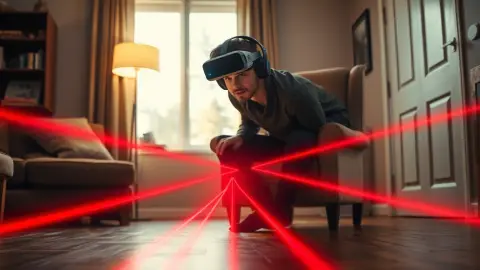
Agility Training Games: A VR Challenge for Parkour Fans
Parkour and movement fans: Laser Thief works as agility training in VR, with ducking, crawling and precise body control. Learn what it trains and what not.
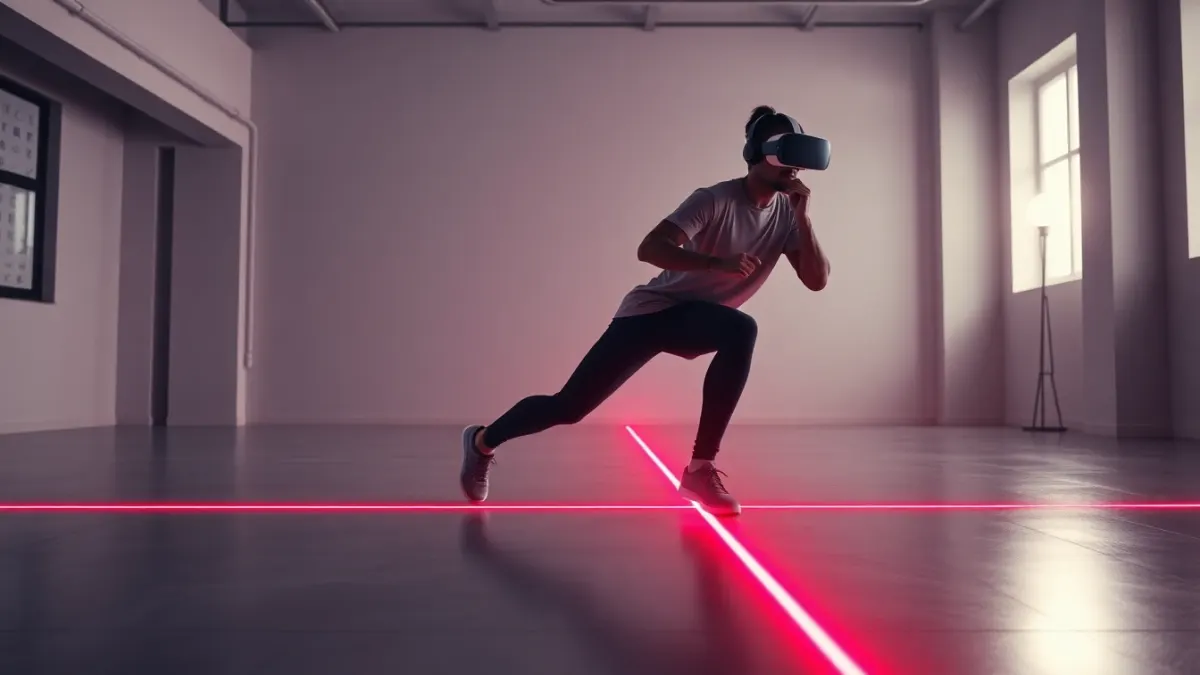
If you spend your weekends vaulting walls, climbing boulders or practising animal flows, most video games look like a waste of a body. Laser Thief is closer to a movement puzzle. It is not agility training in the strict sense, and we will not pretend it replaces proper practice, but as an agility training game it rewards the things movers care about: control, level changes and calm precision.
What the game actually asks of your body
Forget the joystick: the grids are drawn through the colour passthrough of Quest 3 and Quest 3S, so your body does the steering. A beam at knee height means a step over it, a grid near the floor means getting down on all fours. Four moves make up the whole vocabulary:
- Duck: drop under beams that cross at chest height.
- Dodge: lean, twist and step through the openings between beams.
- Crawl: get down low when the grid hugs the floor.
- Reach: stretch out for loot while keeping clear of the light.
For a mover, that sounds familiar: level changes, rotational control, quadrupedal travel and extension under constraint.
Why constraint is the interesting part
A lot of conditioning is about speed or strength. Laser grids are about restraint. Brushing a beam shrinks your shield, and an empty shield ends the heist. That means fast, sloppy movement gets punished. Slow, deliberate movement near beams is safer than fast movement, which is the exact skill set of controlled low-movement practice.
Different grid shapes push you in different ways. A tight vertical gap asks for a narrow lean and hip rotation. A low grid wants a crawl with a held shape. A high-and-low combination wants you to change levels mid-step. The worlds ramp that complexity up: the Money world has the tightest laser grid yet, and Warzone is billed as the final test.
Using the modes as a training tool
If you want to approach it like practice rather than play, the three modes map neatly:
- Free Play is the warm-up and drill space. Random levels, no timer, so you can repeat movements and focus on form.
- Story Mode is skill progression. Each level is a little harder than the last across seven worlds and 150+ levels, so you get a built-in difficulty ladder.
- Bomb Mode is the pressure test. You get 120 seconds to grab as much loot as you can, which forces you to balance speed against control.
Try treating each level as a flow: pick a path through the grid before you move, then execute it smoothly rather than adjusting mid-way.
What it does not replace
Be realistic. There is no resistance, no landing impact, no climbing, no jumping skill in the way parkour trains it. The game does not measure anything, and we will not make claims about athletic gains. It is a fun, physically engaging movement puzzle that can complement your training, especially as a low-impact, indoor, bad-weather option.
Note also that some experienced athletes underestimate it. Crawling and holding low positions is demanding, and repeated crouching can tire knees and shoulders. The game's support page is straightforward: it is more physically demanding than most games, so warm up, play in short sessions and stop if anything hurts.
Safety for people who move fast
Experienced movers tend to push hard, and that is where accidents happen in a headset.
- Keep about 3 × 3 metres (10 × 10 feet) completely clear, and remove coffee tables you might trip over.
- Run Space Setup so the game maps to your real furniture, and keep the boundary features on.
- Wear grippy footwear or go barefoot on a non-slip surface, not socks on hardwood.
- Do not sprint or jump. The game does not ask for it, and the virtual lasers will not stop a real wall.
Is it worth it for you?
If you already own a Quest 3 or 3S and like body-control challenges, it is a fun addition to your rest-day routine. If you do not own the headset, the game alone is probably not a reason to buy one. You can read more on the Laser Thief page or find it on the Meta Horizon Store.
FAQ
Is Laser Thief good agility training?
It trains movement control such as ducking, crawling, leaning and reaching, but it is a game, not a structured training programme, and it does not measure performance.
Do I need to jump?
No. The core moves are duck, dodge, crawl and reach. Jumping is not part of the described gameplay.
Is it hard for athletic people?
Early levels are gentle, and each level gets a little harder. Later worlds like Money and Warzone have tighter grids.
Can I use it as a warm-up?
Free Play, with random levels and no timer, works well for easing in. Do a few minutes of normal mobility work first.