Reading Laser Patterns in Laser Thief Before You Move
Learn to read laser patterns in Laser Thief: scan the grid, find the gaps, order your moves and plan loot routes before you step into the beams.
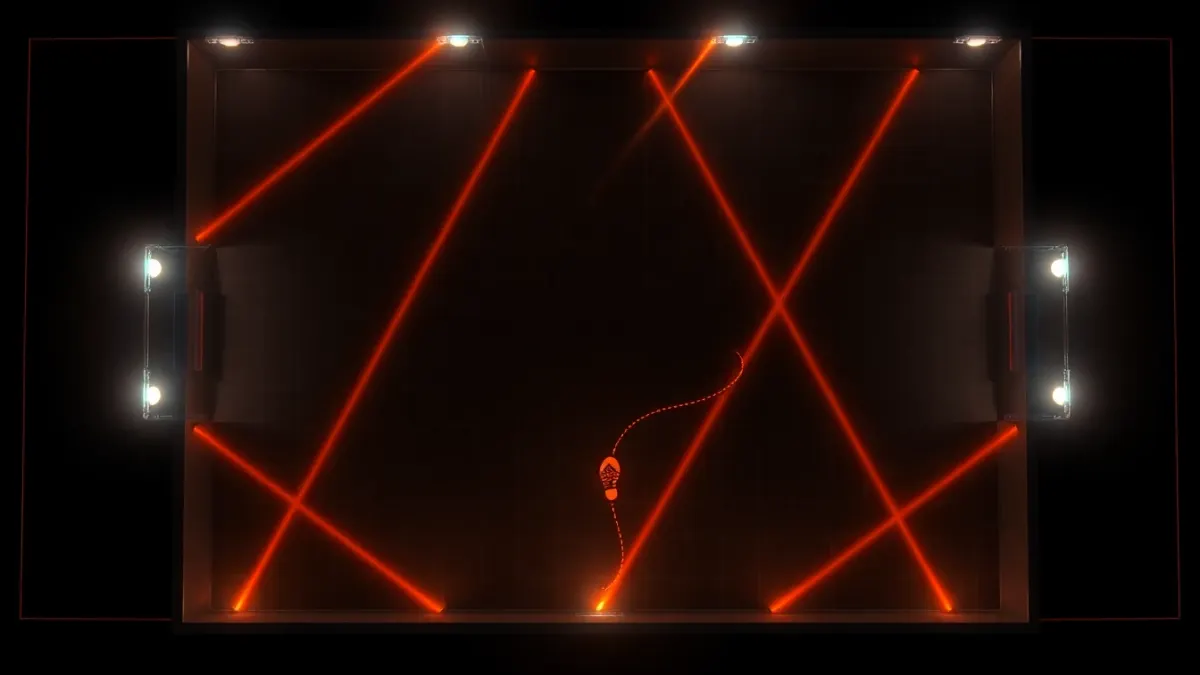
Strong Laser Thief players do not react faster; they read earlier. Reading laser patterns is the habit of spending a few seconds at the start of a level to understand what the room is asking for. It is the cheapest way to save shield.
Start with the big picture
When a level loads, resist the urge to move. Instead, look at the whole space:
- Where is the loot?
- Are the beams mostly high, low or mixed?
- Which area looks most crowded?
The colours in the game can help too. In the screenshots, green and blue grids show up when it is time to get on the floor, while red and yellow beams feature in the dodging shots. Treat colour as a hint, then confirm by checking the height of the beams.
Find the gaps first
A pattern is just a set of gaps. Find the widest ones, then connect them. If you can trace a path from your starting position to the loot using gaps, you have a route. If you cannot, look again: you probably need a crawl or a step somewhere.
Assign a move to each gap
For each part of the route, name the move:
- Duck: beams at chest height.
- Dodge: lean, twist or step through a gap.
- Crawl: a low, tight grid.
- Reach: the final grab.
Saying the moves in your head (duck, step, reach) turns a scary pattern into a short list. Our individual guides on ducking and dodging go through each.
Look two moves ahead
A good player is always planning the next move. While you are in the current gap, glance at the next one. This prevents ending a move in a bad position. For example, finish a duck facing the direction you will step next.
Spot the loot order
If there is more than one item, choose an order that minimises backtracking. A route that sweeps from one side of the room to the other is almost always better than hopping around. In Bomb Mode this matters even more, as our 120-second strategy explains.
Include the hazards
Some worlds add drifting poison bubbles, which punish players who stay still too long. Reading a pattern includes noting where hazards may drift. Plan your route to keep moving.
Trust but verify your view
If a pattern looks wrong, for instance a beam seems to cut through a real wall, your room setup may be out of date. Re-run Space Setup, restart the game and make sure the room is well lit.
Practise reading
Free Play has random levels with no clock, so it is a gym for pattern reading. Try this: for ten levels, take five seconds to name your route out loud before moving. Then compare what you predicted with what happened.
Keep it light
Reading should not freeze you. Five seconds is plenty. Then move slowly and deliberately, which the support notes recommend near beams.
To see what the colour-coded grids look like in action, the screenshots on the Laser Thief page are a good start, and the Meta Horizon Store is where you can pick the game up.
A scanning order you can reuse
Having a fixed scanning order saves mental effort. Try this: first look at the floor, to see whether the grid reaches down to crawl height. Then look at chest height, where ducks happen. Then look at the space around your head and shoulders, where twists and leans are decided. Finally, find the loot and trace a line from your feet to it.
Run through the order the same way every time until it is automatic. After a few days you will find that you take in a pattern in two or three seconds, and that your first move is usually the right one.
If a pattern still looks overwhelming, break it into the nearest three gaps only. You do not need to solve the whole level at once, just the next piece.
FAQ
How do I read laser patterns in Laser Thief?
Scan for loot and gaps, assign a move to each gap, and look two moves ahead before you step in.
Do laser colours mean anything?
The game's screenshots associate green and blue grids with crawling. Use colour as a hint and check beam height.
How long should I study a level before moving?
A few seconds. Enough to plan a route, not enough to freeze.
Can I practise reading patterns without pressure?
Yes, in Free Play, which has no clock.