Why Laser Mazes Are So Much Fun (And Why They Never Get Old)
Why are laser mazes so addictive? Explore the psychology of dodging beams, from heist movies to your living room, and how mixed reality changes the game.
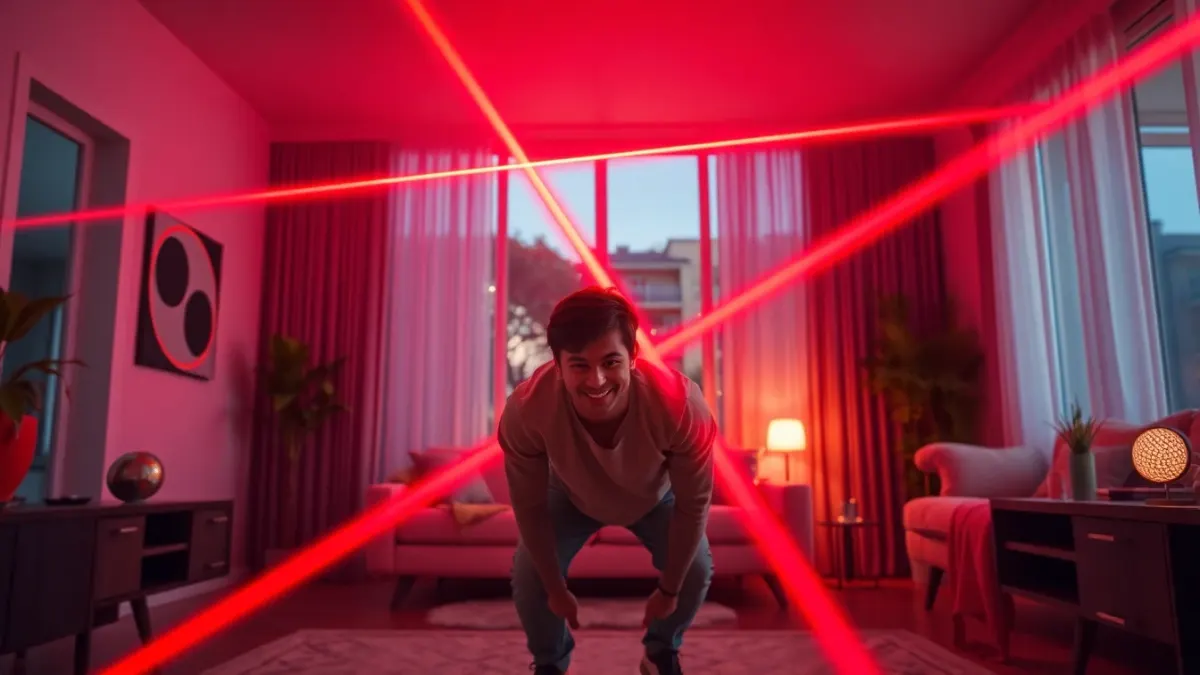
Ask anyone why laser mazes are fun and you will get the same grin before the answer. There is something instantly legible about them: a beam is on, you must not touch it, and the reward is on the other side. No tutorial needed. That simplicity is why the laser maze has survived from film sets to party rooms to headsets, and why Laser Thief on Meta Quest 3 and 3S builds an entire game on it.
A rule you understand in one second
Most games ask you to learn a vocabulary of buttons, menus and systems. A laser grid asks for one thing: do not touch the light. Everyone understands that instantly, from a ten-year-old to a grandparent. When the rule is that clear, all of your attention goes into the fun part, which is figuring out how your body gets through the gap.
Clear rules also make failure feel fair. If a beam catches you, you know exactly why. It was your elbow, your hip, your slightly-too-confident stride. That clarity is the foundation of any good challenge.
Your body becomes the puzzle piece
A laser maze is a spatial puzzle you solve with your own limbs. You look at the pattern, plan a route, and then you have to execute it with balance and coordination. That mix of thinking and moving is rare. Puzzle games exercise the first half; sports exercise the second. Laser mazes need both within the same ten seconds.
In Laser Thief you duck under chest-height beams, lean and twist through gaps, crawl when the grid drops towards the floor and reach for loot without breaking a beam. Those four verbs are the whole toolbox, and the game remixes them across more than 150 levels.
Tension without real danger
Humans enjoy controlled fear. A roller coaster, a horror film and a laser maze all offer the same bargain: your body reacts as if something matters, while you know you are safe. In a laser maze the "danger" is a shrinking score or a lost shield rather than a real injury, so the nervous energy turns into laughter.
In Laser Thief, brushing a beam shrinks your shield, and running out ends the heist. That gives every near-miss a little spike of adrenaline without anything punishing beyond starting the level again.
The heist fantasy
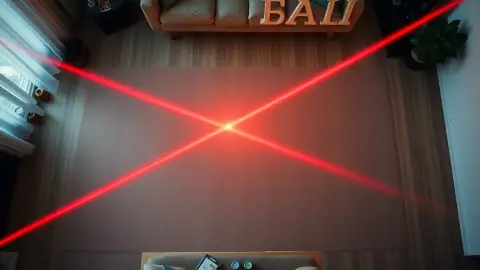
There is a reason the laser corridor is a staple of heist stories: it is the visual shorthand for "this is a place nobody is supposed to get into". Playing through one lets you step into the thief's shoes. You are the one bending backwards through the beams, reaching for the prize, getting out clean.
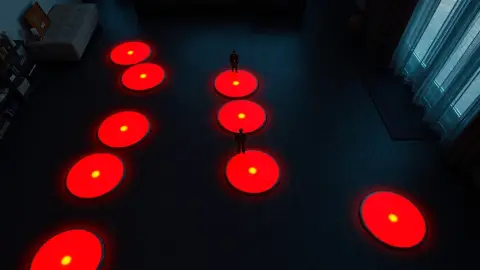
Laser Thief leans into that fantasy with seven worlds, from a kitchen that guards snacks like gold to a vault full of gold bars. The fantasy is not just flavour; it gives each level a goal beyond "survive".
Why it feels better in mixed reality
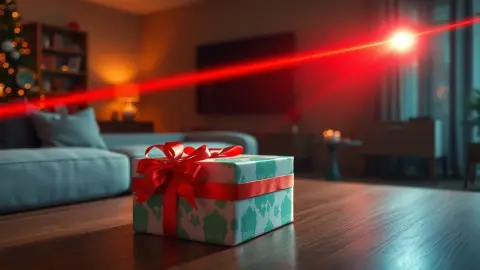
A screen-based laser game can only show you lasers. A mixed reality one puts them in the room you are actually standing in. Meta Quest 3 and 3S use full-colour passthrough, so Laser Thief can draw beams between your real walls and furniture. Your sofa becomes part of the vault. When you step over a beam, you step over it in your own living room.
That is a big deal for believability. The challenge is no longer a picture you look at; it is a space you move through. If you want to read more about how that works in general, see our beginner explainer on mixed reality, or jump straight to the Laser Thief page.
It rewards both caution and boldness
Slow, careful play gets you through a grid, but speed feeds into score-chasing modes. Laser Thief has a 120-second Bomb Mode where greed is rewarded and hesitation is not, a Story Mode that climbs in difficulty, and a no-timer Free Play. That range lets you pick which flavour of tension you want today.
FAQ
Why are laser mazes so addictive?
They combine an instantly understood rule, a physical challenge and a visible reward. Each attempt feels like it could go better with one small adjustment, which encourages "one more try".
Are laser mazes good exercise?
They involve ducking, stretching and crouching, so they can be quite active. Laser Thief describes itself as a workout disguised as a heist, but warm up first and stop if anything hurts.
Do I need a big room to play a laser maze game at home?
Laser Thief recommends a clear area of about 3 × 3 metres (10 × 10 feet). It works in smaller rooms, but the grids are designed around a space you can really move in.
Which headset do I need for Laser Thief?
Meta Quest 3 or Quest 3S. The game relies on colour passthrough and room understanding. You can find it on the official store page or read more on the Laser Thief page.