Ricochet Bullets in Game Design: Why Bouncing Shots Work
Why do bouncing bullets make such good game design? A look at ricochet mechanics, angles and risk, with examples from tank combat in mixed reality.

Ricochet bullets are one of the oldest and best tricks in action design: a projectile that bounces turns every wall into a tool and every shot into a small geometry puzzle. They make combat smarter without making controls harder. Here is why bouncing shots work so well, and how they play out in a mixed reality tank game like Tank Avenger.
The core appeal: geometry as gameplay
When a bullet travels in a straight line, the only question is "can I see the target?" When it bounces, the question becomes "can I reach the target?" That opens up angles, trick shots and the satisfying moment when you hit an enemy hiding behind a block.
It also gives walls two roles: cover for defence and mirrors for offence.
Predictability makes it fair
A bounce only feels fair if the rules are clear. Tank Avenger states them directly in its weapon list:
- Normal Gun: one wall bounce per bullet, the baseline for angle shots.
- Fast Gun: quick repeated fire, and each bullet can rebound twice.
- Heat Gun: bullets that follow the player instead of flying straight.
- Big Gun: oversized explosive shots, a different kind of bounce problem.
- Triple Gun: three bullets per shot, multiplying the possible paths.
- Bomb Thrower: explosives scattered across the battlefield rather than a bouncing shot.
Because "bounce once" and "bounce twice" are crisp rules, you can plan. You are never fighting hidden randomness; you are fighting the geometry.
Risk and reward
Bouncing shots can hit you too. Every wall becomes a liability when you stand in the wrong place. That gives ricochet games an inherent risk-reward loop: bold trick shots win rounds, but sloppy ones come back around.
Different weapons shift that balance. Fast Gun double bounces fill the arena with lines, while the Heat Gun forces you to move, since its bullets track the player. Having several weapon behaviors keeps one approach from dominating.
Why it suits mixed reality especially well
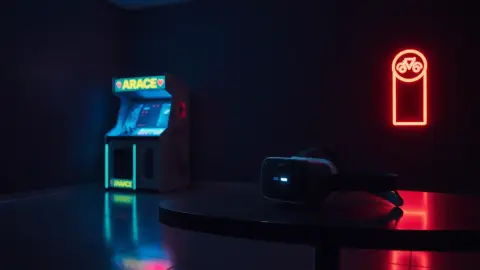
In a headset, you can walk around the arena and look along a shot's line from any angle. Depth cues from two eyes make a bouncing trajectory easier to read than on a flat screen. The arena itself is your real floor, table and walls, so the geometry is physical and familiar.
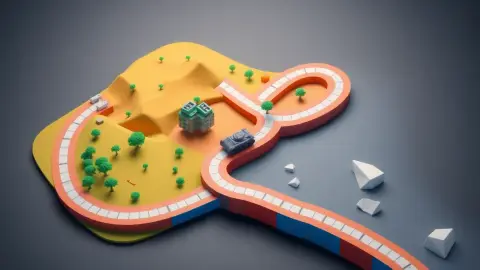
The Ice world pushes this further: slick floors, sliding tanks and shots that keep on going. The Desert offers open sand, long sightlines and nowhere to hide from bouncing shells.
How designers keep bounces fun
- Limit the count. A shot that bounces forever becomes chaos. Capping bounces keeps lines readable.
- Make walls legible. Players must see which surfaces reflect.
- Telegraph danger. A shot should be visible long enough to react.
- Vary the toolset. Tracking shots, explosives and multi-shots create different problems.
- Use level layout. Cover blocks and corridors shape which bounces are possible.
Tips for playing ricochet-based games
- Think of walls as mirrors and draw the line mentally.
- Test the angle with a safe shot before committing.
- Remember your own bounces can return to you.
- Use cover that does not sit along an obvious reflected line.
Where to see it in action
Tank Avenger has 200 levels across four worlds where bouncing shots, abilities like the Shield and Portal, and four game modes work together. The product page shows how the arenas look in a real room.
A tiny design exercise
Imagine an empty square arena with one block in the middle and a single weapon whose bullets bounce once. Where can an enemy hide from a direct shot but not from a bounce? Behind the block, certain angles are safe and others are not. Now give the bullets two bounces and the safe zone shrinks. Playing with this kind of thought experiment shows why a small change in bounce count transforms a level, and why the Normal Gun and Fast Gun feel so different despite similar basic behavior.
FAQ
What does ricochet mean in games?
It means a projectile bounces off a surface instead of stopping. Designers use it to make walls matter for offence as well as defence.
Do bullets bounce in Tank Avenger?
Yes. The Normal Gun's bullets bounce once off walls and the Fast Gun's bounce twice. The Heat Gun's bullets track the player.
Why do bouncing shots feel more skillful?
They require reading angles and planning, so a good shot feels earned rather than lucky.
Can ricochets hit the player who fired them?
In many ricochet games yes, which adds risk. Check each game's rules for how its bullets behave.