Mixed Reality vs Augmented Reality: Headset vs Phone Games
Mixed reality vs augmented reality explained: how headset experiences differ from phone AR, and what that means for active games like Laser Thief.
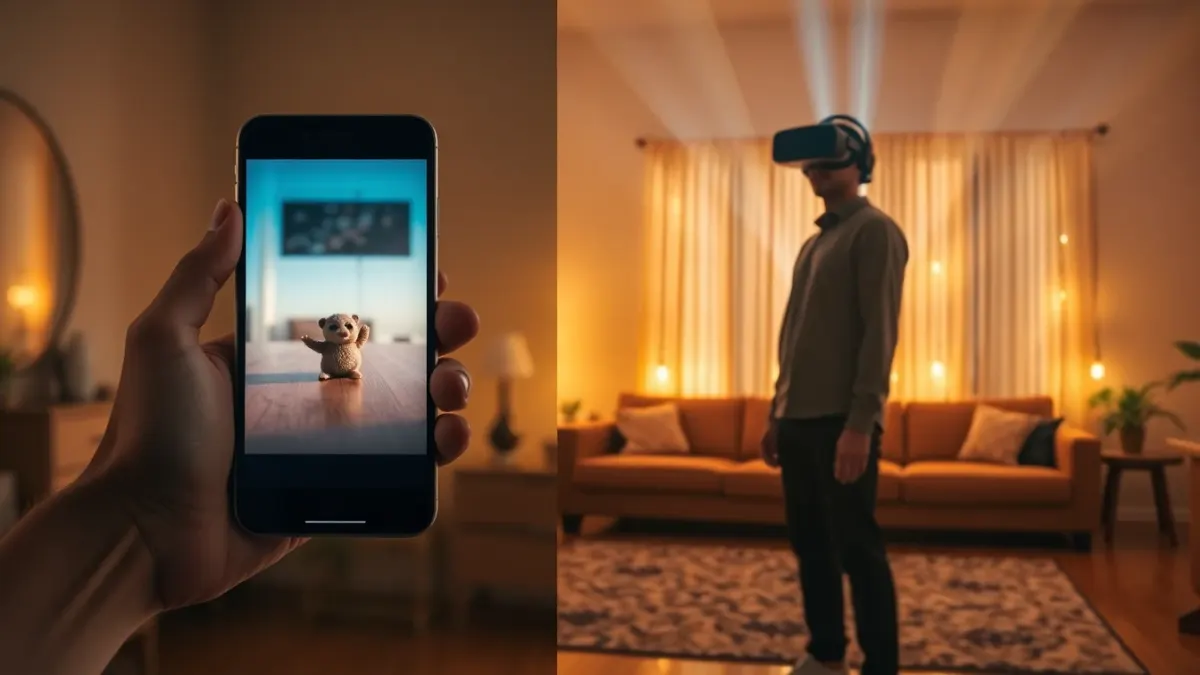
Many people met augmented reality through a phone: hold it up, see a creature on your table, take a picture. Then headsets arrived talking about mixed reality, and the line got blurry. The comparison of mixed reality vs augmented reality is mostly about how much the digital content understands and shares your space, and how you experience it. Here is a clear take.
Augmented reality on a phone
Phone AR uses the camera and sensors to overlay graphics on the real world. You look through a small window: the phone's screen. It works wonderfully for quick, casual things, such as previewing furniture, filters or little characters.
Its limits come from the format. You hold a device in one or two hands, you see the world only through a rectangle, and your body is mostly a camera operator.
Mixed reality on a headset
Mixed reality on devices like Meta Quest 3 and 3S shows the real world through full-colour passthrough on screens right in front of your eyes, and places virtual content that responds to a map of your room. Your hands and body are free, your view is wide, and digital objects can seem to sit on, behind or around real furniture.
The key difference for games is that you are inside the scene, not looking at it.
Where the terms overlap
Honestly, the words overlap. Some people call phone experiences "AR" and headset ones "MR". Others treat MR as an advanced form of AR where virtual and real objects interact. Don't get hung up on the label; ask what the experience lets you do:
- Does it understand walls, floors and furniture?
- Do you use your whole body?
- Are your hands free?
- Does the content stay stable as you walk around?
Why it matters for games
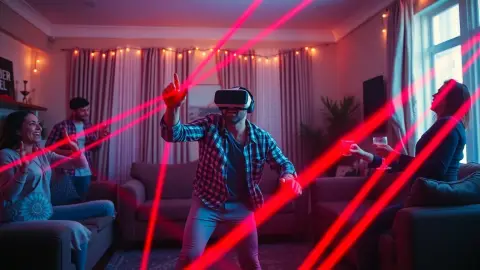
Think of Laser Thief. As a phone game, you would hold up a device and see beams across the room, but you couldn't really duck, dodge and crawl at the same time. On a headset, you do exactly that. The game uses the passthrough cameras to draw laser grids between your real walls and furniture, and you move through them with your body.
Phone AR suits taps and swipes; headset MR suits movement.
Comfort, safety and effort
Phone AR is low effort and low risk, though you can still walk into things while staring at a screen.
Headset MR is more immersive, which means more responsibility. You need clear floor, a lit room and some stamina. Laser Thief's terms ask players to clear about 3 × 3 metres and warn that virtual lasers don't protect you from real furniture.
Privacy considerations
Both use cameras. On a headset, processing of the camera view and room layout generally happens on the device through the platform. Laser Thief states that the game does not record, store or transmit passthrough images and never receives images of your surroundings. As always, read each app's policy.
Which should you try?
- Phone AR if you want something quick, free of extra hardware and easy to share.
- Headset MR if you want to move, to have your hands free and to feel the content around you.
They are complementary rather than competitors. Many people use both without thinking about it.
Getting started with headset MR
- Get a mixed reality-capable headset.
- Run Space Setup so it knows your room.
- Clear a play area.
- Pick a game that clearly supports MR.
- Start with short sessions.
See what it looks like on the Laser Thief page.
A quick mental test
Ask yourself whether you could do the activity while holding a phone with one hand. If yes, it is probably phone AR territory. If it needs both hands free, your whole body or a wide field of view, it belongs on a headset. A game that asks you to crawl under beams plainly fails the one-hand test, which is why it needs mixed reality hardware. This is not a ranking; a phone is far more convenient for a quick filter or a furniture preview.
FAQ
Is mixed reality the same as augmented reality?
They overlap. AR overlays graphics on the real world, often via phone; MR usually implies virtual content that understands and reacts to your space, as on a headset.
Can I play mixed reality games on my phone?
Mixed reality games like Laser Thief are designed for Meta Quest 3 and 3S headsets.
Which is more immersive?
Headset mixed reality, because the content surrounds you and your hands are free.
Do I need special equipment for MR?
A headset with colour passthrough and room understanding, such as Quest 3 or 3S.