Escape Room vs Laser Thief: Puzzle Brains vs Moving Bodies
Escape room vs Laser Thief: how a puzzle-first group experience compares with a mixed reality laser heist that tests your balance, reach and nerve.
Escape rooms and laser games sound like cousins: both put you in a locked-down space with a goal. But the comparison of escape room vs laser game shows they test very different things. One wants your brain, the other wants your balance. If you love escape rooms and you are curious about Laser Thief, here is how they differ and where they overlap.
The core challenge
An escape room is mostly a thinking puzzle. You search, combine clues, decode and open locks, usually as a team under a time limit.
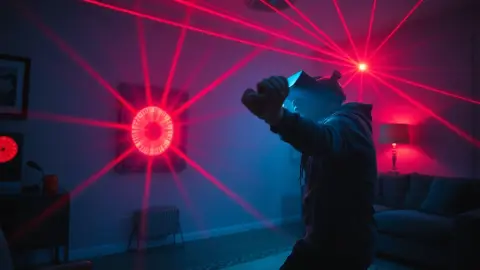
Laser Thief is mostly a movement puzzle. The "clue" is the beam pattern; the "lock" is your own body's ability to fit through the gaps. You duck, dodge, crawl and reach without touching the light.
Where they overlap
- Time pressure: Bomb Mode gives you 120 seconds to grab as much loot as possible before the place goes up.
- Theming: escape rooms use stories; Laser Thief uses seven themed worlds such as Food, Viking, Transport, Garbage, Furniture, Money and Warzone.
- Escalation: both ramp up difficulty.
- Triumph: both reward that moment when the pattern clicks.
Where they differ
People. Escape rooms are almost always group experiences. A headset session is one wearer at a time, though friends can watch and cheer.
Brain vs body. Escape rooms build lateral thinking. Laser Thief builds spatial planning plus physical control.
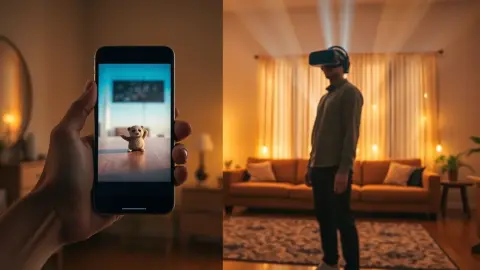
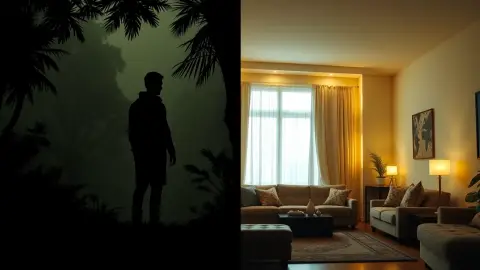
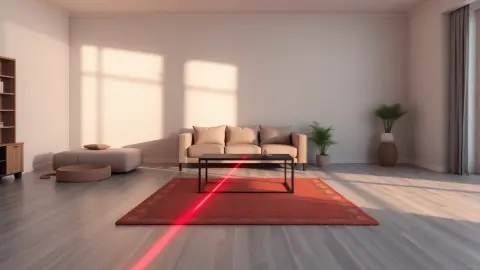
Setting. An escape room is a set built elsewhere. Laser Thief draws its heist inside your own room through mixed reality, using the colour passthrough of Meta Quest 3 and 3S.
Repeatability. An escape room is generally solved once. Laser Thief has 150+ levels and a Free Play mode with random levels, so replaying is built in.
Cost model. Escape rooms are priced per booking; a game is typically a one-off store purchase. Check current pricing on the store.
Which one suits you?
Choose an escape room if you want a social puzzle night and love deduction. Choose Laser Thief if you prefer a quick, physical challenge you can do in your living room, even in ten-minute chunks.
Many puzzle fans will like both, since the planning phase of a laser grid, scanning the pattern and finding a route, is a real puzzle.
A hybrid evening idea
Try this at home: one person plays Laser Thief while the others act as "crew", reading the pattern aloud from outside and calling directions. Rotate players. It's not an official mode, just a house rule, and it brings the escape-room teamwork feel to a solo headset session. Keep spectators out of the play area so nobody is hit.
Tips for puzzle people
- Scan before you move. Treat each grid like a riddle.
- Plan the route, then execute. Rehearse moves mentally.
- Move slowly. Speed is not required for most levels.
- Use Free Play to learn. It has no clock.
Practical details
Laser Thief needs about 3 × 3 metres (10 × 10 feet) of clear floor and a one-time room setup. It stores progress locally on the headset. You can see more on the Laser Thief page.
What escape room veterans notice first
People who are used to escape rooms often notice two things quickly. First, there is no hidden information: every obstacle is visible, so the challenge is execution rather than discovery. Second, failure is cheap. A brushed beam costs you some shield, not the whole run, and you can retry immediately. That makes Laser Thief a calmer relative of the escape room clock: pressure exists mainly in Bomb Mode, and even there a run is capped at 120 seconds.
A note on difficulty
Escape rooms can be brutal if you get stuck on one clue. A movement puzzle is the opposite: you are rarely stuck, only imprecise. If a grid defeats you, change the order of your moves, slow down or try a different approach to the same gap. Often the solution is a lower crouch, a wider step or a slightly different angle of the shoulders.
FAQ
Is Laser Thief like an escape room?
Not exactly. Both are timed challenges, but Laser Thief tests movement and spatial planning in your own room rather than puzzles in a themed set.
Can a group play Laser Thief together?
The game page does not describe multiplayer. Friends can watch and cheer while one person wears the headset.
Is there a time limit in Laser Thief?
Bomb Mode gives you 120 seconds. Free Play has no timer.
Do I need puzzle skills for Laser Thief?
Basic pattern reading helps, but the main skill is controlled movement.