Fixed Path vs Mazing Tower Defense: Two Ways to Build
Fixed path vs mazing tower defense explained: how a set route and an open grid change strategy, and what Sozo's path-based levels reward in VR.
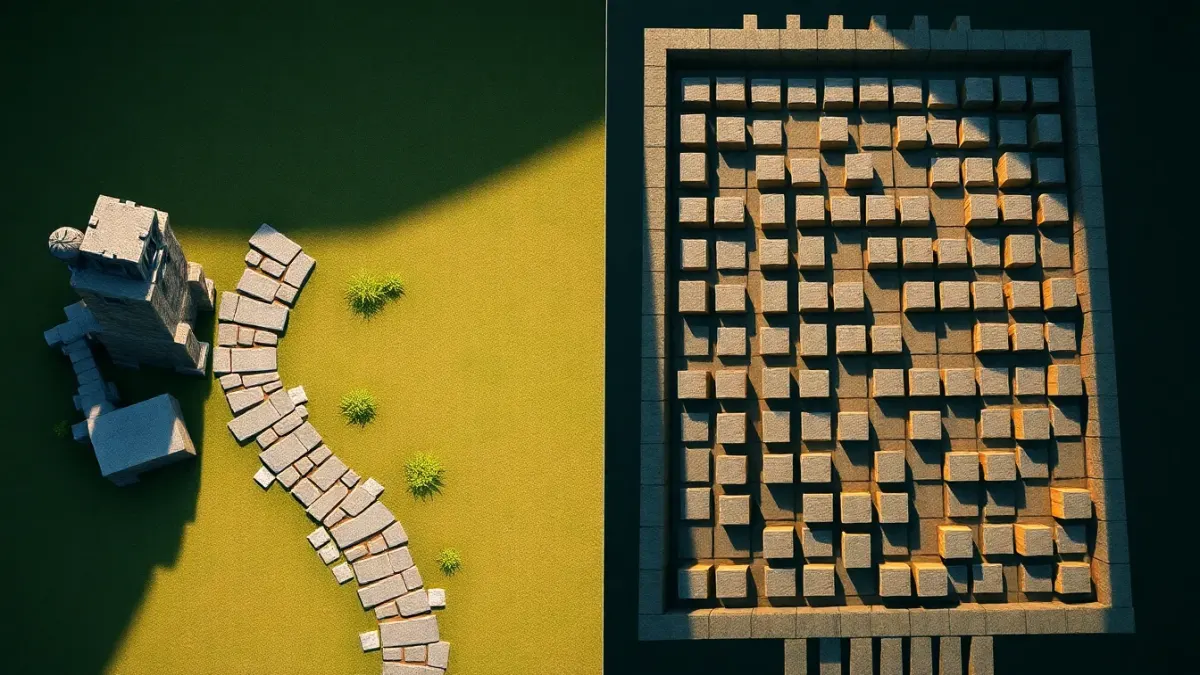
Not every tower defense map works the same way. In some games the enemy route is fixed and you build beside it. In others the field is an open grid, and the towers themselves create the route, a style players call mazing. Knowing which type you are playing changes how you think. This guide compares them.
Fixed path: the route is given
In a fixed-path game, the designer draws the enemy's route. Your job is to choose where on the map to put towers relative to that route.
Core skill: reading geometry. Bends, long straights, proximity to the goal and distance from the path decide the value of each spot.
Strengths
- Easy to understand at a glance.
- Designers can craft memorable maps and set-piece moments.
- Each level has a unique character, since each path is different.
Weaknesses
- Less freedom: the best spots can feel limited.
- Solutions can become "obvious" once you find the key bend.
Mazing: you draw the route
In a mazing game, the enemies follow the shortest open path, and your towers block it. By arranging towers you lengthen the route, forcing enemies to wind back and forth within range.
Core skill: spatial puzzle-solving. You are building a labyrinth that is also your defense.
Strengths
- Huge freedom and creative solutions.
- Rewards mathematical, puzzle-like thinking.
Weaknesses
- Harder to read for newcomers.
- Can feel like solving the same optimisation repeatedly.
- Flyers and special enemies bypass mazes entirely.
Where Sozo sits
Sozo Tower Defense is path-based. The game describes a path at the end of which floats the Core Crystal, and 160 levels each have their own path and waves. You place towers along the path, upgrade them through three tiers and combine them.
That choice suits both VR and mixed reality. A visible route is easy to understand when you are standing in the scene, and in mixed reality the path is laid across your real floor, going around the room layout you confirmed in Space Setup, so you can literally follow it with your eyes.
How strategy differs
| Fixed path | Mazing | |
|---|---|---|
| What you decide | Tower type and position | Tower position as route design |
| Map variety | High (each map different) | Lower (often an open field) |
| Learning curve | Gentle | Steeper |
| Flyers | A special problem | Even more important |
| Feels like | Chess problems | Building a labyrinth |
Skills that transfer
Both rely on the same fundamentals: exposure time, overlap, damage-type matching and upgrade budgeting. If you learn those in a fixed-path game, you can apply them to a mazing game, and vice versa.
Why fixed paths pair well with realm rules
Because the path is set, designers can add realm twists confidently: regenerating monsters, fire puddles, frost bursts, healing, armor, risen dead, phasing and EMP deaths. These rules interact with the geometry. For instance, if dying enemies disable nearby towers, where on the path the kills happen becomes a design question.
Which is for you?
- You like clear, designed challenges: fixed path.
- You like open puzzles and optimisation: mazing.
- You are new to the genre: fixed path is usually friendlier.
- You want a headset game: fixed paths are easier to read in 3D.
Designing for headsets
Fixed paths also help designers solve a headset-specific problem: clarity. In a room, a player needs to understand quickly where enemies will arrive and where they are heading. A single readable route does that at a glance, while a maze changing in real time can be confusing from certain viewpoints. That is one reason many VR and mixed-reality tower defense games favour designed paths.
FAQ
What is mazing in tower defense?
A style where towers are placed on an open grid to lengthen the enemies' route, forming a maze.
Does Sozo use mazing?
Sozo is path-based: towers are placed along a path leading to the Core Crystal.
Do flyers ignore mazes?
In general yes, since flyers do not follow ground routes. In Sozo, flying enemies skip the path entirely. See the Meta store page.