Why Room-Scale Games Feel Different From Anything on a Screen
Why room-scale games feel different: physical movement, real depth and your own space change how you aim, dodge and think. Examples from tank combat.
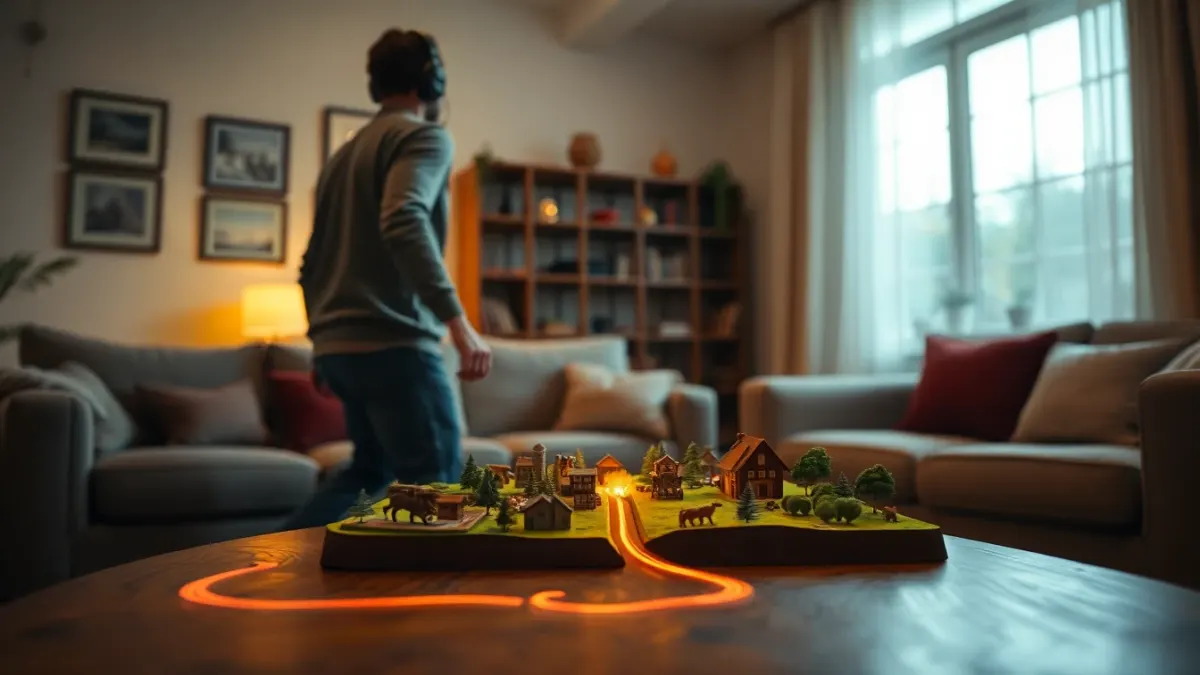
Room-scale games ask you to use the space around you: walking, crouching, leaning and turning, instead of staying planted on a sofa pushing sticks. That small change reshapes how a game feels. You judge distances with your body, aim with your whole posture and remember levels the way you remember places. Here is why that matters, with tank combat as the example.
What "room-scale" means
Room-scale describes games that track your movement through a physical area. You are not just a camera pointed at a world; you occupy a spot in it. In mixed reality, that spot is also a spot in your real room.
Depth you can trust
On a TV, depth is inferred from perspective and shading. In a headset, you see with two eyes at slightly different angles, so a shell moving across the floor really looks nearer or farther. Judging a ricochet is easier when your brain gets real depth cues.
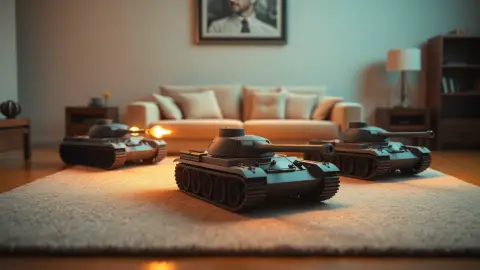
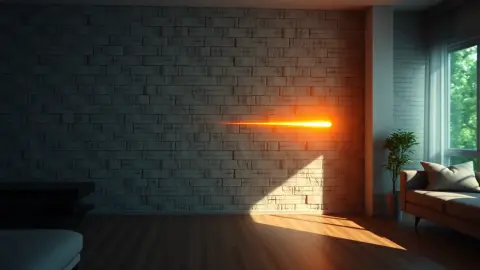
Tank Avenger: Mixed Reality relies on this. Bullets bounce off walls, and with the Fast Gun they bounce twice. Following a bounce across a table you can walk around is more intuitive than tracking one across a flat screen.
Your body becomes the interface
Moving your head to peek around a block is a natural action; no button required. In Tank Avenger, even some special attacks use your hands: when a NUKE is launched at you, you catch it with your own hands and throw it as far away as possible. Then run.
That kind of moment is hard to replicate with a controller on a sofa.
Space becomes memory
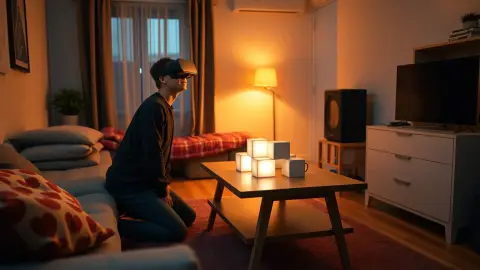
We remember places spatially. After a few sessions, players often recall a level's layout by where things stood relative to their furniture. Tank Avenger's Level Builder leverages this by letting you design battlefields around your real play space: blocks on the coffee table, walls along the sofa and spawn points by the door. Your arena is literally your room, so there is nothing to memorize but the place you already know.
Pace and effort
Room-scale play brings a bit of physical effort. Even gentle stepping and leaning changes the rhythm of a session compared with sitting still. That is one reason shorter sessions and regular breaks make sense. We are not making fitness claims here; just noting that moving is part of the experience.
The trade-offs
- You need space. Tank Avenger's support page suggests a clear area of roughly 2 × 2 metres, though a table can serve as the arena.
- Safety matters. You must clear obstacles, cables and fragile objects.
- Sessions can feel more intense. If you feel dizzy or uncomfortable, stop and rest.
- Not every moment suits it. Some people simply prefer lounging with a controller, and that is fine.
Why mixed reality takes it further
Fully virtual room-scale games hide your room, so you rely on the boundary system. Mixed reality keeps the room visible, so the room itself becomes part of play. The sofa is cover. The table is the map. Supply airdrops land right on it and air strikes fly through your kitchen.
Trying it
If you want to feel the difference without committing to a huge space, a small arena is enough. A clear patch of floor and a headset with passthrough is the entry ticket. Visit the Tank Avenger page to see how its 200 levels use that idea.
A few easy ways to ease in
If you are new to room-scale play, start with short sessions and a small, well-cleared area. Play standing near a table so you have a stable reference point. Stay aware of cables and keep drinks out of reach. After each session, notice how you feel, then extend the time gradually. Treat the first few games as practice for moving with a headset on, rather than a test of skill. Most people find that the awkwardness fades quickly and that moving around a virtual scene starts to feel perfectly natural.
FAQ
What is a room-scale game?
It is a game that tracks your physical movement through an area so walking, crouching and leaning affect play.
Do I need a big room for room-scale games?
Not always. Needs vary by game. Tank Avenger works well with roughly 2 × 2 metres of clear floor, and a coffee table can act as the arena.
Are room-scale games tiring?
They involve more movement than sitting with a gamepad, but intensity depends on the game and how you play. Take breaks and stop if you feel unwell.
Why does depth feel better in a headset?
A headset gives each eye a slightly different view, much like real vision, which makes distances easier to judge than on a flat screen.