What Makes a Good Dodge Game? Design Lessons From Laser Grids
What makes a good dodge game? Learn the design principles behind fair, readable, replayable avoidance games, illustrated with Laser Thief's laser grids.

Dodge games look simple: something dangerous moves, you avoid it. Yet the difference between a great one and a frustrating one is huge. If you have wondered what makes a good dodge game, here are the design ideas that matter, with examples from the laser grids of Laser Thief on Meta Quest 3 and 3S.
1. Readability first
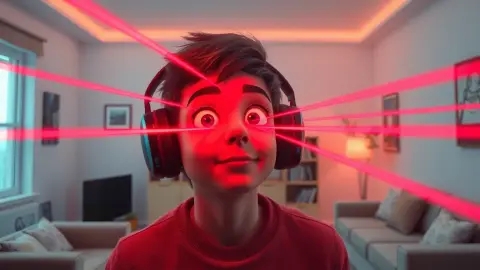
You can only dodge what you can read. A good game makes threats instantly visible and distinguishable. Colour, thickness and contrast do the work. In a laser game, beams glowing against a darker scene tell you where not to be before you think about it.
Mixed reality adds an extra layer: the threat must stand out against your actual room. That is a harder design problem than a black virtual void, and a good reason to use bright, saturated beams.
2. Fairness
When you fail, you should know why. A fair dodge game never hides its rules or kills you from off-screen. Players accept losing when the cause is their own mistake. That is why simple rules like "touching a beam hurts your shield" work so well; there's no arguing with them.
3. A shallow rule set, a deep pattern space
The best dodge games use very few verbs and vary the patterns. Laser Thief's verbs are duck, dodge, crawl and reach. That's it. Variety comes from how beams are arranged, how low or high they sit and how tight the gaps are. Over 150 levels across seven worlds, the same four moves keep feeling fresh because the arrangements change.
4. A difficulty curve that respects the player
Too steep and people quit; too flat and they get bored. Good games teach with easy patterns, then combine ideas, then test mastery. Laser Thief's story mode gets a little harder with every level, and the later worlds, such as the vault and the warzone, demand tighter movement. Pairing that with a no-pressure Free Play mode gives players a place to relax and practise.
5. Risk and reward
Dodging only for survival is dull. Good designs give you something to want that sits near the danger. In Laser Thief you must reach for loot without breaking a beam. In Bomb Mode you have 120 seconds to grab as much as you can: greed is rewarded, hesitation is not. The best moments come when you decide whether to chase a risky target.
6. Feedback that feels good
Feedback tells you what happened: a sound, a flash, a shrinking shield. Laser Thief uses a shield that shrinks when you brush a laser and ends the heist when it runs out, plus a narrator who reacts to your performance. Instant, clear feedback keeps the loop tight and makes failure funny rather than frustrating.
7. Variety of pressure
Even a perfect set of patterns gets stale without new twists. Laser Thief adds elements like poison bubbles that punish standing still for too long, which shifts the strategy from "freeze and think" to "keep moving". Each new rule adds a different sort of tension.
8. Physical comfort
For body-driven dodge games there is another layer: safety and ergonomics. Designers have to think about how low a player must crouch, how long they hold a pose and how big a room is realistic. That's why Laser Thief recommends about 3 × 3 metres and encourages short sessions.
Applying this as a player
Knowing the design helps you play better:
- Scan the whole pattern before moving.
- Pick your route, then move slowly.
- Treat the shield as a budget, not a punishment.
- Use Free Play to practise the awkward moves.
See the game in action on the Laser Thief page.
FAQ
What is a dodge game?
A game whose core challenge is avoiding hazards, from bullets to lasers. In mixed reality, you do the dodging with your body.
Why do some dodge games feel unfair?
Usually because threats are hard to read, rules are unclear or difficulty jumps too quickly.
What is the main challenge in Laser Thief?
Moving through laser grids by ducking, dodging, crawling and reaching without touching a beam.
Do dodge games need fast reflexes?
Not always. Many reward planning and slow, precise movement more than speed.