Your Body as the Controller: How Embodied VR Games Work
Your body as the controller: learn how embodied VR and mixed reality games read head and hand movement, and why that feels so different from buttons.

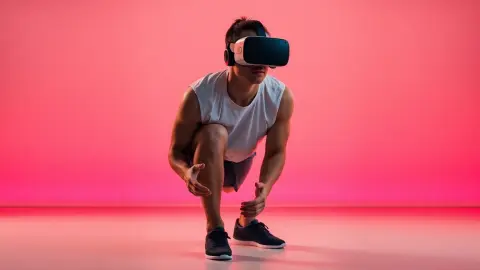
Most video games ask you to press buttons while your body sits still. Body-as-controller VR games flip that: your movement is the input. Stepping left moves you left; crouching makes you small; reaching means reaching. Here is how that works and why it changes the feel of a game.
How the headset reads you
Headsets like Meta Quest 3 and 3S track your head and controllers using on-board cameras and sensors. The game knows where your head is, how high you are crouching, where your hands are and how they move. With mixed reality, it also knows where your walls and furniture are from the room setup.
Laser Thief builds directly on this. Its support notes explain that the shield reacts to your head and hand positions as the headset tracks them.
Why embodiment feels different
When a game uses your body, three things happen:
- Skill is physical. You improve by moving better, not by mashing faster.
- Mistakes are personal. You know exactly which part of you caused it.
- Success is satisfying in a new way. Fitting through a gap feels like solving a puzzle with your limbs.
That is why the movement set in Laser Thief is deliberately small: duck, dodge, crawl, reach. Each one is a body posture you already understand.
The tracking reality
Embodied games depend on tracking, and tracking has quirks:
- Lighting: cameras need a decently lit room.
- Coverage: if your hands leave the cameras' view or a controller is covered, tracking can suffer.
- Occlusion: your body can block parts of itself from view.
- Speed: very fast movements are harder to track cleanly.
This explains the practical advice from Laser Thief's support page: well-lit play area, uncovered controllers, and slow, deliberate movement near beams.
Designing for imperfect tracking
Good embodied games are forgiving in the right places. Beams are thick enough to be readable, gaps are wide enough to hit, and damage is graduated, as with a shield that shrinks when you brush a laser instead of one hit ending the run. Embodiment is thrilling, but it only works if the game respects the limits of the technology.
Getting better at body games
- Warm up. Joints and muscles prefer a gentle start.
- Learn your reach. Spend a few minutes in a relaxed mode to feel your arm length and crouch height.
- Move deliberately. Smooth beats fast.
- Look before you step. Check the real floor, too.
- Keep sessions short. Fatigue reduces control and increases risk.
What body games do for engagement
People often report remembering physical games more vividly than seated ones; that is common sense rather than a scientific claim here. Using your whole body creates stronger memories of "I did that". Mixed reality adds the familiarity of your own room, making the memory attach to a real place.
Limits and inclusivity
Not everyone can crouch, crawl or stretch comfortably. That is fine. Physical games are one option among many. If you have a condition affecting movement, balance or heart health, check with a doctor, and choose seated titles when that suits you better.
For an example built entirely around this idea, see the Laser Thief page.
A five-minute body-awareness warm-up
Before playing a physical game, try a short routine. Stand in the cleared area and slowly lower into a comfortable crouch, then rise. Reach an arm forward, then to each side, and notice where you feel balanced. Step sideways a few times. This tells you how far you can comfortably go before the headset ever sees you move, and it makes the first levels of a game like Laser Thief feel familiar instead of awkward. Finish with a few shoulder rolls and keep water nearby.
FAQ
How do VR headsets know where my body is?
They track your head and controllers with built-in cameras and sensors, and mixed reality adds a map of your room.
Do I need extra sensors on Quest 3?
No. Quest 3 and 3S track using the headset itself.
Why does my shield drop when I didn't touch a beam?
It may be a tracking issue. Improve lighting, uncover the controllers and move slowly near beams.
Is body-driven play good exercise?
It can be active, but intensity varies. Warm up, keep sessions short and stop if anything hurts.